| Benjamin Franklin |
|---|
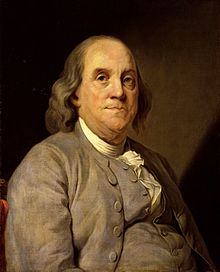 |
|
| 6th President of Pennsylvania |
|---|
In office
October 18, 1785 – November 5, 1788 |
| Vice President | Charles Biddle
Thomas Mifflin |
|---|
| Preceded by | John Dickinson |
|---|
| Succeeded by | Thomas Mifflin |
|---|
| United States Minister to Sweden |
|---|
In office
September 28, 1782 – April 3, 1783 |
| Appointed by | Congress of the Confederation |
|---|
| Preceded by | Position established |
|---|
| Succeeded by | Jonathan Russell |
|---|
| United States Minister to France |
|---|
In office
September 14, 1778 – May 17, 1785
Serving with Arthur Lee, Silas Deane, John Adams |
| Appointed by | Continental Congress |
|---|
| Preceded by | Position established |
|---|
| Succeeded by | Thomas Jefferson |
|---|
| 1st United States Postmaster General |
|---|
In office
July 26, 1775 – November 7, 1776 |
| Preceded by | Position established |
|---|
| Succeeded by | Richard Bache |
|---|
| Speaker of the Pennsylvania Assembly |
|---|
In office
May 1764 – October 1764 |
| Preceded by | Isaac Norris |
|---|
| Succeeded by | Isaac Norris |
|---|
| Personal details |
|---|
| Born | January 17, 1706
Boston, Massachusetts Bay,British America |
|---|
| Died | April 17, 1790 (aged 84)
Philadelphia, Pennsylvania,U.S. |
|---|
| Political party | Independent |
|---|
| Spouse(s) | Deborah Read |
|---|
| Children | William
Francis
Sarah |
|---|
| Signature |  |
|---|
Benjamin Franklin (January 17, 1706 [
O.S. January 6, 1705]
[1] – April 17, 1790) was one of the
Founding Fathers of the United States. A renowned
polymath, Franklin was a leading author, printer,
political theorist, politician, freemason, postmaster, scientist, inventor, civic activist, statesman, and diplomat. As a scientist, he was a major figure in the
American Enlightenment and the
history of physics for his discoveries and theories regarding electricity. As an inventor, he is known for the
lightning rod,
bifocals, and the
Franklin stove, among other inventions.
[2] He facilitated many civic organizations, including Philadelphia's fire department and a university.
[3]
Franklin earned the title of "The First American" for his early and indefatigable campaigning for
colonial unity, first as an author and spokesman in London for several colonies. As the first
United States Ambassador to France, he exemplified the emerging American nation.
[4] Franklin was foundational in defining the American ethos as a marriage of the practical values of thrift, hard work, education, community spirit, self-governing institutions, and opposition to authoritarianism both political and religious, with the scientific and tolerant values of the
Enlightenment. In the words of historian
Henry Steele Commager, "In a Franklin could be merged the virtues of
Puritanismwithout its defects, the illumination of the Enlightenment without its heat."
[5] To
Walter Isaacson, this makes Franklin "the most accomplished American of his age and the most influential in inventing the type of society America would become."
[6]
He played a major role in establishing the
University of Pennsylvania and was elected the first president of the
American Philosophical Society. Franklin became a national hero in America when as agent for several colonies he spearheaded the effort to have Parliament in London repeal the unpopular
Stamp Act. An accomplished diplomat, he was widely admired among the French as American minister to Paris and was a major figure in the development of positive
Franco-American relations. His efforts to secure support for the
American Revolution by shipments of crucial munitions proved vital for the American war effort.
For many years he was the British postmaster for the colonies, which enabled him to set up the first national communications network. He was active in community affairs, colonial and state politics, as well as national and international affairs. From 1785 to 1788, he served as
governor of Pennsylvania. Toward the end of his life, he freed his own slaves and became one of the most prominent
abolitionists.
His colorful life and legacy of scientific and political achievement, and status as one of America's most influential Founding Fathers, have seen Franklin honored on
coinage and the
$100 bill;
warships;
the names of many towns; counties; educational institutions; corporations; and, more than two centuries after his death, countless
cultural references.
Early life in Boston

Franklin's birthplace on
Milk Street, Boston, Massachusetts
Josiah wanted Ben to attend school with the clergy, but only had enough money to send him to school for two years. He attended
Boston Latin School but did not graduate; he continued his education through voracious reading. Although "his parents talked of the church as a career"
[8]for Franklin, his schooling ended when he was ten. He worked for his father for a time, and at 12 he became an
apprentice to his brother James, a printer, who taught Ben the printing trade. When Ben was 15, James founded
The New-England Courant, which was
the first truly independent newspaper in the colonies.
When denied the chance to write a letter to the paper for publication, Franklin adopted the pseudonym of "
Mrs. Silence Dogood", a middle-aged widow. Mrs. Dogood's letters were published, and became a subject of conversation around town. Neither James nor the
Courant's readers were aware of the ruse, and James was unhappy with Ben when he discovered the popular correspondent was his younger brother. Franklin was an advocate of free speech from an early age. When his brother was jailed for three weeks in 1722 for publishing material unflattering to the governor, young Franklin took over the newspaper and had Mrs. Dogood (quoting
Cato's Letters) proclaim: "Without freedom of thought there can be no such thing as wisdom and no such thing as public liberty without freedom of speech."
[9] Franklin left his apprenticeship without his brother's permission, and in so doing became a
fugitive.
[10]
Philadelphia
At age 17, Franklin ran away to Philadelphia, Pennsylvania, seeking a new start in a new city. When he first arrived, he worked in several printer shops around town, but he was not satisfied by the immediate prospects. After a few months, while working in a printing house, Franklin was convinced by Pennsylvania Governor
Sir William Keith to go to
London, ostensibly to acquire the equipment necessary for establishing another newspaper in Philadelphia. Finding Keith's promises of backing a newspaper empty, Franklin worked as a
typesetter in a printer's shop in what is now the
Church of St Bartholomew-the-Great in the
Smithfield area of London. Following this, he returned to Philadelphia in 1726 with the help of Thomas Denham, a merchant who employed Franklin as clerk, shopkeeper, and bookkeeper in his business.
[10]
Junto and library
In 1727, Benjamin Franklin, then 21, created the
Junto, a group of "like minded aspiring artisans and tradesmen who hoped to improve themselves while they improved their community." The Junto was a discussion group for issues of the day; it subsequently gave rise to many organizations in Philadelphia.
[11] The Junto was modeled after English coffeehouses that Franklin knew well, and which should become the center of the spread of Enlightenment ideas in Britain.
[12][13]
Reading was a great pastime of the Junto, but books were rare and expensive. The members created a library initially assembled from their own books after Franklin wrote:
A proposition was made by me that since our books were often referr'd to in our disquisitions upon the inquiries, it might be convenient for us to have them altogether where we met, that upon occasion they might be consulted; and by thus clubbing our books to a common library, we should, while we lik'd to keep them together, have each of us the advantage of using the books of all the other members, which would be nearly as beneficial as if each owned the whole.
[14]
Newspaperman
Upon Denham's death, Franklin returned to his former trade. In 1728, Franklin had set up a printing house in partnership with
Hugh Meredith; the following year he became the publisher of a newspaper called
The Pennsylvania Gazette. The
Gazette gave Franklin a forum for agitation about a variety of local reforms and initiatives through printed essays and observations. Over time, his commentary, and his adroit cultivation of a positive image as an industrious and intellectual young man, earned him a great deal of social respect. But even after Franklin had achieved fame as a scientist and statesman, he habitually signed his letters with the unpretentious 'B. Franklin, Printer.'
[10]
In 1732, Ben Franklin published the first
German language newspaper in America –
Die Philadelphische Zeitung – although it failed after only one year, because four other newly founded German papers quickly dominated the newspaper market.
[16] Franklin printed Moravian religious books in German. Franklin often visited Bethlehem staying at the
Moravian Sun Inn.
[17] In a 1751 pamphlet on demographic growth and its implications for the colonies, he called the
Pennsylvania Germans "Palatine Boors" who could never acquire the "Complexion" of the English settlers and to "Blacks and Tawneys" as weakening the social structure of the colonies. Although Franklin apparently reconsidered shortly thereafter, and the phrases were omitted from all later printings of the pamphlet, his views may have played a role in his political defeat in 1764.
[18]
Franklin saw the printing press as a device to instruct colonial Americans in moral virtue. Frasca argues he saw this as a service to God, because he understood moral virtue in terms of actions, thus, doing good provides a service to God. Despite his own moral lapses, Franklin saw himself as uniquely qualified to instruct Americans in morality. He tried to influence American moral life through construction of a printing network based on a chain of partnerships from the Carolinas to New England. Franklin thereby invented the first newspaper chain. It was more than a business venture, for like many publishers since, he believed that the press had a public-service duty.
[19]
When Franklin established himself in Philadelphia, shortly before 1730, the town boasted two "wretched little" news sheets,
Andrew Bradford's
American Mercury, and
Samuel Keimer's
Universal Instructor in all Arts and Sciences, and Pennsylvania Gazette. This instruction in all arts and sciences consisted of weekly extracts from
Chambers's Universal Dictionary. Franklin quickly did away with all this when he took over the
Instructor and made it
The Pennsylvania Gazette. The
Gazette soon became Franklin's characteristic organ, which he freely used for satire, for the play of his wit, even for sheer excess of mischief or of fun. From the first he had a way of adapting his models to his own uses. The series of essays called "The Busy-Body", which he wrote for Bradford's
American Mercury in 1729, followed the general
Addisonian form, already modified to suit homelier conditions. The thrifty Patience, in her busy little shop, complaining of the useless visitors who waste her valuable time, is related to the ladies who address Mr. Spectator. The Busy-Body himself is a true Censor Morum, as
Isaac Bickerstaff had been in the
Tatler. And a number of the fictitious characters, Ridentius, Eugenius, Cato, and Cretico, represent traditional 18th-century classicism. Even this Franklin could use for contemporary satire, since Cretico, the "sowre Philosopher", is evidently a portrait of Franklin's rival,
Samuel Keimer.
As time went on, Franklin depended less on his literary conventions, and more on his own native humor. In this there is a new spirit—not suggested to him by the fine breeding of
Addison, or the bitter irony of
Swift, or the stinging completeness of
Pope. The brilliant little pieces Franklin wrote for his
Pennsylvania Gazette have an imperishable place in American literature.
The Pennsylvania Gazette, like most other newspapers of the period, was often poorly printed. Franklin was busy with a hundred matters outside of his printing office, and never seriously attempted to raise the mechanical standards of his trade. Nor did he ever properly edit or collate the chance medley of stale items that passed for news in the Gazette. His influence on the practical side of journalism was minimal. On the other hand, his advertisements of books show his very great interest in popularizing secular literature. Undoubtedly his paper contributed to the broader culture that distinguished Pennsylvania from her neighbors before the Revolution. Like many publishers, Franklin built up a book shop in his printing office; he took the opportunity to read new books before selling them.
Franklin had mixed success in his plan to establish an inter-colonial network of newspapers that would produce a profit for him and disseminate virtue.
[20] He began in
Charleston, South Carolina, in 1731. After the second editor died, his widow Elizabeth Timothy took over and made it a success, 1738–46. She was one of the colonial era's first woman printers.
[21] For three decades Franklin maintained a close business relationship with her and her son Peter who took over in 1746.
[22] The
Gazette had a policy of impartiality in political debates, while creating the opportunity for public debate, which encouraged others to challenge authority. Editor Peter Timothy avoided blandness and crude bias, and after 1765 increasingly took a patriotic stand in the growing crisis with Great Britain.
[23] However, Franklin's
Connecticut Gazette (1755–68) proved unsuccessful.
[24]
Freemason
In 1731, Franklin was initiated into the local
Masonic Lodge. He became Grand Master in 1734, indicating his rapid rise to prominence in Pennsylvania.
[25][26] That same year, he edited and published the first Masonic book in the Americas, a reprint of
James Anderson's Constitutions of the Free-Masons. Franklin remained a Freemason for the rest of his life.
[27][28]
Common-law marriage to Deborah Read
In 1723, at the age of 17, Franklin proposed to 15-year-old
Deborah Read while a boarder in the Read home. At that time, Read's mother was wary of allowing her young daughter to marry Franklin, who was on his way to London at Governor
Sir William Keith's request, and also because of his financial instability. Her own husband had recently died, and Mrs. Read declined Franklin's request to marry her daughter.
[10]
While Franklin was in London, his trip was extended, and there were problems with Sir William's promises of support. Perhaps because of the circumstances of this delay, Deborah married a man named John Rodgers. This proved to be a regrettable decision. Rodgers shortly avoided his debts and prosecution by fleeing to
Barbados with her
dowry, leaving Deborah behind. Rodgers's fate was unknown, and because of
bigamy laws, Deborah was not free to remarry.
Franklin established a
common-law marriage with Deborah Read on September 1, 1730. They took in Franklin's young, recently acknowledged illegitimate son,
William, and raised him in their household. In addition, they had two children together. The first,
Francis Folger Franklin, born October 1732, died of
smallpox in 1736. Their second child,
Sarah Franklin, familiarly called Sally, was born in 1743. She eventually married
Richard Bache, had seven children, and cared for her father in his old age.
Deborah's fear of the sea meant that she never accompanied Franklin on any of his extended trips to Europe, despite his repeated requests. She wrote to him in November 1769 saying she was ill due to "dissatisfied distress" from his prolonged absence, but he did not return until his business was done.
[29] Deborah Read Franklin died of a stroke in 1774, while Franklin was on an extended mission to England; he returned in 1775.
William Franklin
In 1730, at the age of 24, Franklin publicly acknowledged the existence of William, his son, who was deemed 'illegitimate' as he was born out of wedlock, and raised him in his household. His mother's identity is not known.
[30] He was educated in Philadelphia.
Beginning at about age 30, William studied law in London in the early 1760s. He fathered an illegitimate son,
William Temple Franklin, born February 22, 1762. The boy's mother was never identified, and he was placed in foster care. Franklin later that year married Elizabeth Downes, daughter of a
planter from
Barbados. After William passed the bar, his father helped him gain an appointment in 1763 as the last
Royal Governor of New Jersey.
A
Loyalist, William and his father eventually broke relations over their differences about the American Revolutionary War. The elder Franklin could never accept William's position. Deposed in 1776 by the revolutionary government of New Jersey, William was arrested at his home in
Perth Amboy at the
Proprietary House and imprisoned for a time. The younger Franklin went to New York in 1782, which was still occupied by British troops. He became leader of the Board of Associated Loyalists — a quasi-military organization, headquartered in
New York City. They initiated guerrilla forays into
New Jersey, southern
Connecticut, and
New York counties north of the city.
[31] When British troops evacuated from New York, William Franklin left with them and sailed to England. He settled in London, never to return to North America.
In the preliminary peace talks in 1782 with Britain, "... Benjamin Franklin insisted that loyalists who had borne arms against the United States would be excluded from this plea (that they be given a general pardon). He was undoubtedly thinking of William Franklin."
[32]
Success as an author

Franklin's
The General Magazine and Historical Chronicle(Jan. 1741)
In 1733, Franklin began to publish the noted
Poor Richard's Almanack (with content both original and borrowed) under the pseudonym Richard Saunders, on which much of his popular reputation is based. Franklin frequently wrote under pseudonyms. Although it was no secret that Franklin was the author, his Richard Saunders character repeatedly denied it. "Poor Richard's Proverbs", adages from this almanac, such as "A penny saved is twopence dear" (often misquoted as "A penny saved is a penny earned") and "Fish and visitors stink in three days", remain common quotations in the modern world. Wisdom in folk society meant the ability to provide an apt adage for any occasion, and Franklin's readers became well prepared. He sold about ten thousand copies per year (a circulation equivalent to nearly three million today).
[10] In 1741 Franklin began publishing
The General Magazine and Historical Chronicle for all the British Plantations in America, the first such monthly magazine of this type published in America.
In 1758, the year he ceased writing for the Almanack, he printed
Father Abraham's Sermon, also known as
The Way to Wealth. Franklin's
autobiography, begun in 1771 but published after his death, has become one of the classics of the genre.
Inventions and scientific inquiries
Franklin was a prodigious inventor. Among his many creations were the
lightning rod,
glass armonica (a glass instrument, not to be confused with the metal harmonica),
Franklin stove,
bifocal glasses and the flexible
urinary catheter. Franklin never patented his inventions; in his
autobiographyhe wrote, "... as we enjoy great advantages from the inventions of others, we should be glad of an opportunity to serve others by any invention of ours; and this we should do freely and generously."
[35]
His inventions also included
social innovations, such as
paying forward. Franklin's fascination with innovation could be viewed as altruistic; he wrote that his scientific works were to be used for increasing efficiency and human improvement. One such improvement was his effort to expedite news services through his printing presses.
[36]
Population studies
Franklin had a major influence on the emerging science of
demography, or population studies.
[37] Thomas Malthus is noted for his rule of population growth and credited Franklin for discovering it.
[38] Kammen (1990) and Drake (2011) say Franklin's "
Observations on the Increase of Mankind" (1755) stands alongside
Ezra Stiles' "Discourse on Christian Union" (1760) as the leading works of eighteenth century Anglo-American demography; Drake credits Franklin's "wide readership and prophetic insight."
[39][40]
In the 1730s and 1740s, Franklin began taking notes on population growth, finding that the American population had the fastest growth rates on earth.
[41] Emphasizing that population growth depended on food supplies—a line of thought later developed by
Thomas Malthus—Franklin emphasized the abundance of food and available farmland in America. He calculated that America's population was doubling every twenty years and would surpass that of England in a century.
[42] In 1751, he drafted "Observations concerning the Increase of Mankind, Peopling of Countries, &c." Four years later, it was anonymously printed in Boston, and it was quickly reproduced in Britain, where it influenced the economists
Adam Smith and later
Thomas Malthus. Franklin's predictions alarmed British leaders who did not want to be surpassed by the colonies, so they became more willing to impose restrictions on the colonial economy.
[43]
Franklin was also a pioneer in the study of slave demography, as shown in his 1755 essay.
[44]
Atlantic Ocean currents
As deputy postmaster, Franklin became interested in the
North Atlantic Ocean circulation patterns. While in England in 1768, he heard a complaint from the Colonial Board of Customs: Why did it take British packet ships carrying mail several weeks longer to reach New York than it took an average merchant ship to reach
Newport, Rhode Island? The merchantmen had a longer and more complex voyage because they left from London, while the packets left from
Falmouth in Cornwall.
Franklin put the question to his cousin Timothy Folger, a
Nantucket whaler captain, who told him that merchant ships routinely avoided a strong eastbound mid-ocean current. The mail packet captains sailed dead into it, thus fighting an adverse current of 3 miles per hour (5 km/h). Franklin worked with Folger and other experienced ship captains, learning enough to chart the current and name it the
Gulf Stream, by which it is still known today.
Franklin published his Gulf Stream chart in 1770 in England, where it was completely ignored. Subsequent versions were printed in France in 1778 and the U.S. in 1786. The British edition of the chart, which was the original, was so thoroughly ignored that everyone assumed it was lost forever until Phil Richardson, a
Woods Hole oceanographer and Gulf Stream expert, discovered it in the
Bibliothèque Nationale in Paris in 1980.
[45][46] This find received front page coverage in the
New York Times.
[47]
It took many years for British sea captains to adopt Franklin's advice on navigating the current; once they did, they were able to trim two weeks from their sailing time.
[48][49] In 1853, the oceanographer and cartographer
Matthew Fontaine Maury noted that Franklin only charted and codified the Gulf Stream, he did not
discover it:
Though it was Dr. Franklin and Captain Tim Folger, who first turned the Gulf Stream to nautical account, the discovery that there was a Gulf Stream cannot be said to belong to either of them, for its existence was known to
Peter Martyr d'Anghiera, and to
Sir Humphrey Gilbert, in the 16th century.
[50]
Electricity

Franklin and Electricity vignette
engraved by the
BEP (c. 1860).
Franklin's discoveries resulted from his investigations of
electricity. Franklin proposed that "vitreous" and "resinous" electricity were not different types of "
electrical fluid" (as electricity was called then), but the same electrical fluid under different pressures. He was the first to label them as
positive and negative respectively,
[51] and he was the first to discover the principle of
conservation of charge.
[52]
In 1750, he published a proposal for an experiment to prove that
lightning is electricity by
flying a kite in a storm that appeared capable of becoming a lightning storm. On May 10, 1752,
Thomas-François Dalibard of France conducted Franklin's experiment using a 40-foot-tall (12 m) iron rod instead of a kite, and he extracted electrical sparks from a cloud. On June 15 Franklin may possibly have conducted his well known kite experiment
in Philadelphia, successfully extracting sparks from a cloud. Franklin's experiment was not written up with credit
[53] until
Joseph Priestley's 1767
History and Present Status of Electricity; the evidence shows that Franklin was insulated (not in a conducting path, where he would have been in danger of
electrocution). Others, such as Prof.
Georg Wilhelm Richmann, were indeed electrocuted during the months following Franklin's experiment.
In his writings, Franklin indicates that he was aware of the dangers and offered alternative ways to demonstrate that lightning was electrical, as shown by his use of the concept of
electrical ground. If Franklin did perform this experiment, he may not have done it in the way that is often described—flying the kite and waiting to be struck by lightning—as it would have been dangerous.
[54] Instead he used the kite to collect some electric charge from a storm cloud, which implied that lightning was electrical.
[citation needed] On October 19 in a letter to England with directions for repeating the experiment, Franklin wrote:
When rain has wet the kite twine so that it can conduct the electric fire freely, you will find it streams out plentifully from the key at the approach of your knuckle, and with this key a phial, or
Leyden jar, may be charged: and from electric fire thus obtained spirits may be kindled, and all other electric experiments [may be] performed which are usually done by the help of a rubber glass globe or tube; and therefore the sameness of the electrical matter with that of lightening completely demonstrated.
[55]
Franklin's electrical experiments led to his invention of the
lightning rod. He noted that conductors with a sharp rather than a smooth point could discharge silently, and at a far greater distance. He surmised that this could help protect buildings from lightning by attaching "upright Rods of Iron, made sharp as a Needle and gilt to prevent Rusting, and from the Foot of those Rods a Wire down the outside of the Building into the Ground; ... Would not these pointed Rods probably draw the Electrical Fire silently out of a Cloud before it came nigh enough to strike, and thereby secure us from that most sudden and terrible Mischief!" Following a series of experiments on Franklin's own house, lightning rods were installed on the Academy of Philadelphia (later the
University of Pennsylvania) and the Pennsylvania State House (later Independence Hall) in 1752.
[56]
In recognition of his work with electricity, Franklin received the
Royal Society's
Copley Medal in 1753, and in 1756 he became one of the few 18th-century Americans elected as a Fellow of the Society. The
cgs unit of electric charge has been named after him: one
franklin (Fr) is equal to one
statcoulomb.
Wave theory of light
Meteorology
On October
21, 1743, according to popular myth, a storm moving from the southwest denied Franklin the opportunity of witnessing a
lunar eclipse. Franklin was said to have noted that the
prevailing winds were actually from the northeast, contrary to what he had expected. In correspondence with his brother, Franklin learned that the same storm had not reached Boston until after the eclipse, despite the fact that Boston is to the northeast of Philadelphia. He deduced that storms do not always travel in the direction of the prevailing wind, a concept that greatly influenced
meteorology.
[58]
After the Icelandic volcanic eruption of
Laki in 1783, and the subsequent harsh European winter of 1784, Franklin made observations connecting the causal nature of these two separate events. He wrote about them in a lecture series.
[59]
Traction kiting
Though Benjamin Franklin has been most noted kite-wise with his lightning experiments, he has also been noted by many for his using kites to pull humans and ships across waterways.
[60] The
George Pocock in the book
A TREATISE on The Aeropleustic Art, or Navigation in the Air, by means of Kites, or Buoyant Sails[61] noted being inspired by Benjamin Franklin's traction of his body by kite power across a waterway. In his later years he suggested using the technique for pulling ships.
Concept of cooling
Franklin noted a principle of
refrigeration by observing that on a very hot day, he stayed cooler in a wet shirt in a breeze than he did in a dry one. To understand this phenomenon more clearly Franklin conducted experiments. In 1758 on a warm day in
Cambridge, England, Franklin and fellow scientist
John Hadley experimented by continually wetting the ball of a mercury
thermometer with
ether and using
bellows to evaporate the ether.
[62] With each subsequent
evaporation, the thermometer read a lower temperature, eventually reaching 7 °F (−14 °C). Another thermometer showed that the room temperature was constant at 65 °F (18 °C). In his letter
Cooling by Evaporation, Franklin noted that, "One may see the possibility of freezing a man to death on a warm summer's day."
Temperature's effect on electrical conductivity
According to
Michael Faraday, Franklin's experiments on the non-conduction of ice are worth mentioning, although the law of the general effect of liquefaction on electrolytes is not attributed to Franklin.
[63] However, as reported in 1836 by Prof. A. D. Bache of the University of Pennsylvania, the law of the effect of heat on the conduction of bodies otherwise non-conductors, for example, glass, could be attributed to Franklin. Franklin writes, "... A certain quantity of heat will make some bodies good conductors, that will not otherwise conduct ..." and again, "... And water, though naturally a good conductor, will not conduct well when frozen into ice."
[64]
Oceanography findings
An aging Franklin accumulated all his oceanographic findings in
Maritime Observations, published by the Philosophical Society's
transactions in 1786.
[65] It contained ideas for
sea anchors,
catamaran hulls,
watertight compartments, shipboard lightning rods and a soup bowl designed to stay stable in stormy weather.
Decision-making
... my Way is, to divide half a Sheet of Paper by a Line into two Columns, writing over the one
Pro, and over the other
Con. Then during three or four Days Consideration I put down under the different Heads short Hints of the different Motives that at different Times occur to me for or against the Measure. When I have thus got them all together in one View, I endeavour to estimate their respective Weights; and where I find two, one on each side, that seem equal, I strike them both out: If I find a Reason
pro equal to some two Reasons
con, I strike out the three. If I judge some two Reasons
con equal to some three Reasons
pro, I strike out the five; and thus proceeding I find at length where the Ballance lies; and if after a Day or two of farther Consideration nothing new that is of Importance occurs on either side, I come to a Determination accordingly.
[66]
Oil on water

An illustration from Franklin's paper on "
Water-spouts and Whirlwinds"
While traveling on a ship, Franklin had observed that the wake of a ship was diminished when the cooks scuttled their greasy water. He studied the effects at
Clapham Common,
London on a large pond there. "I fetched out a cruet of oil and dropt a little of it on the water...though not more than a teaspoon full, produced an instant calm over a space of several yards square." He later used the trick to "calm the waters" by carrying "a little oil in the hollow joint of my cane".
[67]
Musical endeavors
Franklin is known to have played the violin, the
harp, and the guitar. He also composed music, notably a
string quartet in
early classical style. He developed a much-improved version of the
glass harmonica, in which the glasses rotate on a shaft, with the player's fingers held steady, instead of the other way around; this version soon found its way to Europe.
[68]
Chess
Franklin was an avid
chess player. He was playing chess by around 1733, making him the first chess player known by name in the American colonies.
[69] His essay on "
The Morals of Chess" in
Columbian magazine in December 1786 is the second known writing on chess in America.
[69] This essay in praise of chess and prescribing a code of behavior for the game has been widely reprinted and translated.
[70][71][72][73]He and a friend also used chess as a means of learning the
Italian language, which both were studying; the winner of each game between them had the right to assign a task, such as parts of the Italian grammar to be learned by heart, to be performed by the loser before their next meeting.
[74]
Franklin was able to play chess more frequently against stronger opposition during his many years as a civil servant and diplomat in England, where the game was far better established than in America. He was able to improve his playing standard by facing more experienced players during this period. He regularly attended the Old Slaughter's Coffee House in London for chess and socializing, making many important personal contacts. While in Paris, both as a visitor and later as ambassador, he visited the famous
Café de la Regence, which France's strongest players made their regular meeting place. No records of his games have survived, so it is not possible to ascertain his playing strength in modern terms.
[75]
Franklin was inducted into the
U.S. Chess Hall of Fame in 1999.
[69] The Franklin Mercantile Chess Club in Philadelphia, the second oldest chess club in the U.S., is named in his honor.
Public life
Early steps in Pennsylvania
In 1736, Franklin created the
Union Fire Company, one of the first
volunteer firefighting companies in America. In the same year, he printed a new currency for
New Jersey based on innovative anti-
counterfeiting techniques he had devised. Throughout his career, Franklin was an advocate for
paper money, publishing
A Modest Enquiry into the Nature and Necessity of a Paper Currency in 1729, and his printer printed money. He was influential in the more restrained and thus successful monetary experiments in the Middle Colonies, which stopped
deflationwithout causing excessive inflation. In 1766 he made a case for paper money to the
British House of Commons.
[76]
As he matured, Franklin began to concern himself more with public affairs. In 1743, he first devised a scheme for
The Academy, Charity School, and College of Philadelphia. However, the person he had in mind to run the academy, Rev.
Richard Peters, refused and Franklin put his ideas away until 1749, when he printed his own pamphlet,
Proposals Relating to the Education of Youth in Pensilvania.[77]:30 He was appointed president of the Academy on November 13, 1749; the Academy and the Charity School opened on August 13, 1751.
In 1743, Franklin founded the
American Philosophical Society to help scientific men discuss their discoveries and theories. He began the electrical research that, along with other scientific inquiries, would occupy him for the rest of his life, in between bouts of politics and moneymaking.
[10]
In 1747, he retired from printing and went into other businesses.
[78] He created a partnership with his foreman, David Hall, which provided Franklin with half of the shop's profits for 18 years. This lucrative business arrangement provided leisure time for study, and in a few years he had made discoveries that gave him a reputation with educated persons throughout Europe and especially in France.
Franklin became involved in Philadelphia politics and rapidly progressed. In October 1748, he was selected as a councilman, in June 1749 he became a
Justice of the Peace for Philadelphia, and in 1751 he was elected to the
Pennsylvania Assembly. On August 10, 1753, Franklin was appointed deputy postmaster-general of
British North America, (
see below). His most notable service in domestic politics was his reform of the postal system, with mail sent out every week.
[10]
In 1751, Franklin and
Dr. Thomas Bond obtained a charter from the Pennsylvania legislature to establish a hospital.
Pennsylvania Hospital was the first hospital in what was to become the United States of America.
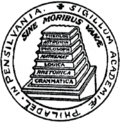
Seal of the College of Philadelphia
In June 1753, Johnson, Franklin, and Smith met in Stratford.
[82] They decided the new-model college would focus on the professions, with classes taught in English instead of Latin, have subject matter experts as professors instead of one tutor leading a class for four years, and there would be no religious test for admission.
[83] Johnson went on to found King's College (now
Columbia University) in New York City in 1754, while Franklin hired Smith as Provost of the College of Philadelphia, which opened in 1755. At its first commencement, on May 17, 1757, seven men graduated; six with a
Bachelor of Arts and one as
Master of Arts. It was later merged with the University of the State of Pennsylvania to become the
University of Pennsylvania. The College was to become influential in guiding
the founding documents of the United States: in the
Continental Congress, for example, over one third of the college-affiliated men who contributed the
Declaration of Independence between September 4, 1774, and July 4, 1776, were affiliated with the College.
[84]
In 1754, he headed the Pennsylvania delegation to the
Albany Congress. This meeting of several colonies had been requested by the
Board of Trade in England to improve relations with the Indians and defense against the French. Franklin proposed a broad
Plan of Union for the colonies. While the plan was not adopted, elements of it found their way into the
Articles of Confederation and the
Constitution.
In 1756, Franklin organized the Pennsylvania Militia (see "Associated Regiment of Philadelphia" under heading of Pennsylvania's 103rd Artillery and
111th Infantry Regiment at
Continental Army). He used
Tun Tavern as a gathering place to recruit a regiment of soldiers to go into battle against the
Native American uprisings that beset the American colonies. Reportedly Franklin was elected "Colonel" of the Associated Regiment but declined the honor.
Decades in London

Franklin in London, 1767, wearing a blue suit with elaborate gold braid and buttons, a far cry from the simple dress he affected at the
French court in later years. Painting by
David Martin, displayed in the
White House.
From the mid 1750s to the mid 1770s, Franklin spent much of his time in London. Officially he was there on a political mission, but he used his time to further his scientific explorations as well, meeting many notable people.
In 1757, he was sent to England by the Pennsylvania Assembly as a colonial agent to protest against the political influence of the
Penn family, the
proprietors of the colony. He remained there for five years, striving to end the proprietors' prerogative to overturn legislation from the elected Assembly, and their exemption from paying taxes on their land. His lack of influential allies in
Whitehall led to the failure of this mission.
At this time, many members of the Pennsylvania Assembly were feuding with
William Penn's heirs, who controlled the colony as proprietors. After his return to the colony, Franklin led the "anti-proprietary party" in the struggle against the Penn family, and was elected
Speaker of the Pennsylvania House in May 1764. His call for a change from proprietary to royal government was a rare political miscalculation, however: Pennsylvanians worried that such a move would endanger their political and religious freedoms. Because of these fears, and because of political attacks on his character, Franklin lost his seat in the October 1764 Assembly elections. The anti-proprietary party dispatched Franklin to England again to continue the struggle against the Penn family proprietorship. During this trip, events drastically changed the nature of his mission.
[88]
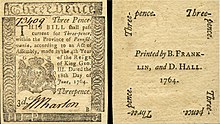
Pennsylvania colonial currency printed by Franklin in 1764
In London, Franklin opposed the
1765 Stamp Act. Unable to prevent its passage, he made another political miscalculation and recommended a friend to the post of stamp distributor for Pennsylvania. Pennsylvanians were outraged, believing that he had supported the measure all along, and threatened to destroy his home in Philadelphia. Franklin soon learned of the extent of colonial resistance to the Stamp Act, and he testified during the House of Commons proceedings that led to its repeal.
[89]
With this, Franklin suddenly emerged as the leading spokesman for American interests in England. He wrote popular essays on behalf of the colonies.
Georgia,
New Jersey, and
Massachusetts also appointed him as their agent to the Crown.
[88]
Franklin lodged in a house in Craven Street, just off
The Strand in
central London. During his stays there, he developed a close friendship with his landlady, Margaret Stevenson, and her circle of friends and relations, in particular her daughter Mary, who was more often known as Polly. Their house, which he used on various lengthy missions from 1757 to 1775, is the only one of his residences to survive. It opened to the public as the
Benjamin Franklin House museum in 2006.
In 1756, Franklin had become a member of the Society for the Encouragement of Arts, Manufactures & Commerce (now the
Royal Society of Arts or RSA), which had been founded in 1754 and whose early meetings took place in
Covent Garden coffee shops. After his return to the United States in 1775, Franklin became the Society's Corresponding Member, continuing a close connection. The RSA instituted a
Benjamin Franklin Medal in 1956 to commemorate the 250th anniversary of his birth and the 200th anniversary of his membership of the RSA.
While living in London in 1768,
he developed a phonetic alphabet in
A Scheme for a new Alphabet and a Reformed Mode of Spelling. This reformed alphabet discarded six letters Franklin regarded as redundant (c, j, q, w, x, and y), and substituted six new letters for sounds he felt lacked letters of their own. His new alphabet, however, never caught on, and he eventually lost interest.
[90]
Travels around Britain and Ireland
He had never been to
Ireland before, and met and stayed with
Lord Hillsborough, who he believed was especially attentive. Franklin noted of him that "all the plausible behaviour I have described is meant only, by patting and stroking the horse, to make him more patient, while the reins are drawn tighter, and the spurs set deeper into his sides."
[94] In
Dublin, Franklin was invited to sit with the members of the
Irish Parliament rather than in the gallery. He was the first American to receive this honor.
[91] While touring Ireland, he was moved by the level of poverty he saw. Ireland's economy was affected by the same trade regulations and laws of Britain that governed America. Franklin feared that America could suffer the same effects should Britain's "colonial exploitation" continue.
[95]
Visits to Europe
Franklin spent two months in German lands in 1766, but his connections to the country stretched across a lifetime. He declared a debt of gratitude to German scientist
Otto von Guericke for his early studies of electricity. Franklin also co-authored the first
treaty of friendship between Prussia and America in 1785.
In September 1767, Franklin visited Paris with his usual traveling partner,
Sir John Pringle. News of his electrical discoveries was widespread in France. His reputation meant that he was introduced to many influential scientists and politicians, and also to
King Louis XV.
[96]
Defending the American cause
One line of argument in Parliament was that Americans should pay a share of the costs of the
French and Indian War, and that therefore taxes should be levied on them. Franklin became the American spokesman in highly publicized testimony in Parliament in 1766. He stated that Americans already contributed heavily to the defense of the Empire. He said local governments had raised, outfitted and paid 25,000 soldiers to fight France—as many as Britain itself sent—and spent many millions from American treasuries doing so in the
French and Indian War alone.
[97][98]
Hutchinson letters
In June 1773 Franklin obtained private letters of
Thomas Hutchinson and
Andrew Oliver, governor and lieutenant governor of the
Province of Massachusetts Bay, that proved they were encouraging the Crown to crack down on the rights of Bostonians. Franklin sent them to America, where they escalated the tensions. The British began to regard him as the fomenter of serious trouble. Hopes for a peaceful solution ended as he was systematically ridiculed and humiliated by
Solicitor-General Alexander Wedderburn, before the
Privy Council on January 29, 1774. He returned to Philadelphia in March 1775, and abandoned his accommodationist stance.
[100]
Coming of revolution
In 1763, soon after Franklin returned to Pennsylvania from England for the first time, the western frontier was engulfed in a bitter war known as
Pontiac's Rebellion. The
Paxton Boys, a group of settlers convinced that the Pennsylvania government was not doing enough to protect them from
American Indian raids, murdered a group of peaceful
SusquehannockIndians and marched on Philadelphia. Franklin helped to organize a local
militia to defend the capital against the mob. He met with the Paxton leaders and persuaded them to disperse. Franklin wrote a scathing attack against the
racial prejudice of the Paxton Boys. "If an
Indian injures me," he asked, "does it follow that I may revenge that Injury on all
Indians?"
[101]
He provided an early response to British surveillance through his own network of
counter-surveillance and manipulation. "He waged a public relations campaign, secured secret aid, played a role in privateering expeditions, and churned out effective and inflammatory propaganda."
[102]
Declaration of Independence
By the time Franklin arrived in Philadelphia on May 5, 1775, after his second mission to Great Britain, the
American Revolution had begun – with fighting between colonials and British at
Lexington and Concord. The New England militia had trapped the main British army in Boston. The Pennsylvania Assembly unanimously chose Franklin as their delegate to the
Second Continental Congress. In June 1776, he was appointed a member of the
Committee of Five that drafted the
Declaration of Independence. Although he was temporarily disabled by
gout and unable to attend most meetings of the Committee, Franklin made several "small but important"
[104] changes to the draft sent to him by
Thomas Jefferson.
At the signing, he is quoted as having replied to a comment by
Hancock that they must all hang together: "Yes, we must, indeed, all hang together, or most assuredly we shall all hang separately."
[105]
Postmaster
-
Well known as a printer and publisher, Franklin was appointed postmaster of Philadelphia in 1737, holding the office until 1753, when he and publisher
William Hunter were named deputy postmasters–general of British North America, the first to hold the office. (
Joint appointments were standard at the time, for political reasons.) Franklin was responsible for the British colonies as far as the
island of Newfoundland, opening Canada's first post office at
Halifax,
Nova Scotia, while Hunter became postal administrator in
Williamsburg,
Virginia and oversaw areas south of
Annapolis,
Maryland. Franklin reorganized the service's accounting system, then improved speed of delivery between Philadelphia, New York and Boston. By 1761, efficiencies lead to the first profits for the colonial post office.
[106]
When the lands of
New France were ceded to the British under the
Treaty of Paris in 1763, the new British
province of Quebec was created among them, and Franklin saw mail service expanded between
Montreal,
Trois-Rivières,
Quebec City, and New York. For the greater part of his appointment, Franklin lived in England (from 1757 to 1762, and again from 1764 to 1774) – about three-quarters of his term.
[107] Eventually, his sympathies for the rebel cause in the American Revolution led to his dismissal on January 31, 1774.
On July 26, 1775, the
Second Continental Congress established the
United States Post Office and named Benjamin Franklin as the first
United States Postmaster General. Franklin had been a postmaster for decades and was a natural choice for the position.
[108] He had just returned from England and was appointed chairman of a Committee of Investigation to establish a postal system. The report of the Committee, providing for the appointment of a postmaster general for the 13 American colonies, was considered by the Continental Congress on July 25 and 26. On July 26, 1775, Franklin was appointed Postmaster General, the first appointed under the Continental Congress. It established a postal system that became the United States Post Office, a system that continues to operate today.
[109]
Ambassador to France: 1776–1785

Franklin, in his
fur hat, charmed the French with what they perceived as rustic New World
genius.
[Note 2]
In December 1776, Franklin was dispatched to France as
commissioner for the United States. He took with him as secretary his 16-year-old grandson,
William Temple Franklin. They lived in a home in the Parisian suburb of
Passy, donated by
Jacques-Donatien Le Ray de Chaumont, who supported the United States. Franklin remained in France until 1785. He conducted the affairs of his country toward the French nation with great success, which included securing a critical military alliance in 1778 and negotiating the
Treaty of Paris (1783).
Among his associates in France was
Honoré Gabriel Riqueti, comte de Mirabeau—a French Revolutionary writer, orator and statesman who in early 1791 would be elected president of the
National Assembly.
[110] In July 1784, Franklin met with Mirabeau and contributed anonymous materials that the Frenchman used in his first signed work:
Considerations sur l'ordre de Cincinnatus.
[111] The publication was critical of the
Society of the Cincinnati, established in the United States. Franklin and Mirabeau thought of it as a "noble order", inconsistent with the
egalitarian ideals of the new republic.
[112]

While in France Franklin designed and commissioned
Augustin Dupré to engrave the medallion
"Libertas Americana" minted in Paris in 1783.
Franklin's advocacy for religious tolerance in France contributed to arguments made by French philosophers and politicians that resulted in
Louis XVI's signing of the
Edict of Versailles in November 1787. This edict effectively nullified the
Edict of Fontainebleau, which had denied non-Catholics civil status and the right to openly practice their faith.
[115]
Constitutional Convention
Between 1771 and 1788, he finished his
autobiography. While it was at first addressed to his son, it was later completed for the benefit of mankind at the request of a friend.
In those wretched countries where a man cannot call his tongue his own, he can scarce call anything his own. Whoever would overthrow the liberty of a nation must begin by subduing the freeness of speech ...
Without freedom of thought there can be no such thing as wisdom, and no such thing as public liberty without freedom of speech, which is the right of every man ...
- —Silence Dogood no. 8, 1722[121]
In his later years, as Congress was forced to deal with the issue of
slavery, Franklin wrote several essays that stressed the importance of the
abolition of slavery and of the integration of blacks into American society. These writings included:
In 1790,
Quakers from New York and Pennsylvania presented their petition for abolition to Congress. Their argument against slavery was backed by the
Pennsylvania Abolitionist Society and its president, Benjamin Franklin.
President of Pennsylvania

Franklin autograph check signed during his Presidency of Pennsylvania
Special balloting conducted October 18, 1785, unanimously elected Franklin the sixth
president of the
Supreme Executive Council of Pennsylvania, replacing
John Dickinson. The office was practically that of
governor. Franklin held that office for slightly over three years, longer than any other, and served the constitutional limit of three full terms. Shortly after his initial election he was reelected to a full term on October 29, 1785, and again in the fall of 1786 and on October 31, 1787. In that capacity he served as host to the Constitutional Convention of 1787 in Philadelphia.
[123]
Virtue, religion, and personal beliefs

Voltaire blessing Franklin's grandson, in the name of God and Liberty, by
Pedro Américo
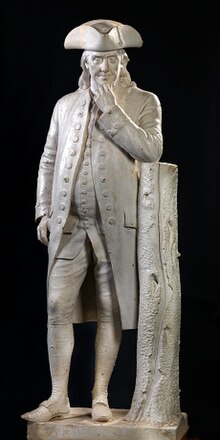
Benjamin Franklin by Hiram Powers
Like the other advocates of
republicanism, Franklin emphasized that the new republic could survive only if the people were virtuous. All his life he explored the role of civic and personal virtue, as expressed in
Poor Richard's aphorisms. Franklin felt that organized religion was necessary to keep men good to their fellow men, but rarely attended religious services himself.
[124] When Franklin met
Voltaire in Paris and asked this great apostle of the Enlightenment to bless his grandson, Voltaire said in English, "God and Liberty," and added, "this is the only appropriate benediction for the grandson of Monsieur Franklin."
[125]
Franklin's parents were both pious
Puritans.
[126] The family attended the
Old South Church, the most liberal Puritan congregation in Boston, where Benjamin Franklin was baptized in 1706.
[127] Franklin's father, a poor
chandler, owned a copy of a book,
Bonifacius: Essays to Do Good, by the Puritan preacher and family friend
Cotton Mather, which Franklin often cited as a key influence on his life.
[128] Franklin's first pen name, Silence Dogood, paid homage both to the book and to a widely known sermon by Mather. The book preached the importance of forming voluntary associations to benefit society. Franklin learned about forming do-good associations from Cotton Mather, but his organizational skills made him the most influential force in making voluntarism an enduring part of the American ethos.
[129]
Franklin formulated a presentation of his beliefs and published it in 1728.
[130] It did not mention many of the Puritan ideas as regards belief in salvation, the
divinity of Jesus, and indeed most religious dogma. He clarified himself as a
deist in his 1771 autobiography,
[131] although he still considered himself a Christian.
[132] He retained a strong faith in a God as the wellspring of morality and goodness in man, and as a Providential actor in history responsible for American independence.
[133]
It was Ben Franklin who, at a critical impasse during the
Constitutional Convention in June 1787, attempted to introduce the practice of daily common prayer with these words:
... In the beginning of the contest with G. Britain, when we were sensible of danger we had daily prayer in this room for the Divine Protection. – Our prayers, Sir, were heard, and they were graciously answered. All of us who were engaged in the struggle must have observed frequent instances of a Superintending providence in our favor. ... And have we now forgotten that powerful friend? or do we imagine that we no longer need His assistance. I have lived, Sir, a long time and the longer I live, the more convincing proofs I see of this truth – that God governs in the affairs of men. And if a sparrow cannot fall to the ground without his notice, is it probable that an empire can rise without his aid? We have been assured, Sir, in the sacred writings that "except the Lord build they labor in vain that build it." I firmly believe this; and I also believe that without his concurring aid we shall succeed in this political building no better than the Builders of Babel: ... I therefore beg leave to move – that henceforth prayers imploring the assistance of Heaven, and its blessings on our deliberations, be held in this Assembly every morning before we proceed to business, and that one or more of the Clergy of this City be requested to officiate in that service.
[134]
However, the motion met with resistance and was never brought to a vote.
[135]
Franklin was an enthusiastic supporter of the evangelical minister
George Whitefield during the
First Great Awakening. Franklin did not subscribe to Whitefield's theology, but he admired Whitefield for exhorting people to worship God through good works. Franklin published all of Whitefield's sermons and journals, thereby boosting the Great Awakening.
[136]
When he stopped attending church, Franklin wrote in his autobiography:
... Sunday being my studying day, I never was without some religious principles. I never doubted, for instance, the existence of the Deity; that He made the world, and governed it by His providence; that the most acceptable service of God was the doing good to man; that our souls are immortal; and that all crime will be punished, and virtue rewarded, either here or hereafter.
[137][138]
Franklin retained a lifelong commitment to the Puritan virtues and political values he had grown up with, and through his civic work and publishing, he succeeded in passing these values into the American culture permanently. He had a "passion for virtue".
[139] These Puritan values included his devotion to egalitarianism, education, industry, thrift, honesty, temperance, charity and community spirit.
[140]
The classical authors read in the Enlightenment period taught an abstract
ideal of republican government based on hierarchical social orders of king, aristocracy and commoners. It was widely believed that English liberties relied on their balance of power, but also hierarchal deference to the privileged class.
[141] "Puritanism ... and the epidemic evangelism of the mid-eighteenth century, had created challenges to the traditional notions of social stratification"
[142] by preaching that the Bible taught all men are equal, that the true value of a man lies in his moral behavior, not his class, and that all men can be saved.
[142] Franklin, steeped in Puritanism and an enthusiastic supporter of the evangelical movement, rejected the salvation dogma, but embraced the radical notion of egalitarian democracy.
Franklin's commitment to teach these values was itself something he gained from his Puritan upbringing, with its stress on "inculcating virtue and character in themselves and their communities."
[143] These Puritan values and the desire to pass them on, were one of Franklin's quintessentially American characteristics, and helped shape the character of the nation. Franklin's writings on
virtue were derided by some European authors, such as Jackob Fugger in his critical work
Portrait of American Culture.
Max Weber considered Franklin's ethical writings a culmination of the
Protestant ethic, which ethic created the social conditions necessary for the birth of
capitalism.
[144]
One of Franklin's notable characteristics was his respect, tolerance and promotion of all churches. Referring to his experience in Philadelphia, he wrote in
his autobiography, "new Places of worship were continually wanted, and generally erected by voluntary Contribution, my Mite for such purpose, whatever might be the Sect, was never refused."
[137] "He helped create a new type of nation that would draw strength from its religious pluralism."
[145] The first generation of Puritans had been intolerant of
dissent, but by the early 18th century, when Franklin grew up in the Puritan church, tolerance of different churches was the norm, and Massachusetts was known, in
John Adams' words, as "the most mild and equitable establishment of religion that was known in the world."
[146] The evangelical revivalists who were active mid-century, such as Franklin's friend and preacher, George Whitefield, were the greatest advocates of religious freedom, "claiming liberty of conscience to be an 'inalienable right of every rational creature.'"
[147] Whitefield's supporters in Philadelphia, including Franklin, erected "a large, new hall, that ... could provide a pulpit to anyone of any belief."
[148] Franklin's rejection of dogma and doctrine and his stress on the God of ethics and morality and
civic virtue made him the "prophet of tolerance."
[145] Franklin composed "A Parable Against Persecution", an apocryphal 51st chapter of Genesis in which God teaches Abraham the duty of tolerance.
[149] While he was living in London in 1774, he was present at the birth of
British Unitarianism, attending the inaugural session of the
Essex Street Chapel, at which
Theophilus Lindsey drew together the first avowedly
Unitarian congregation in England; this was somewhat politically risky, and pushed religious tolerance to new boundaries, as a denial of the doctrine of the
Trinity was illegal until
the 1813 Act.
[150]
Although Franklin's parents had intended for him to have a career in the Church,
[8] Franklin as a young man adopted the Enlightenment religious belief in
deism, that God's truths can be found entirely through nature and reason.
[151] "I soon became a thorough Deist."
[152] As a young man he rejected Christian dogma in a 1725 pamphlet
A Dissertation on Liberty and Necessity, Pleasure and Pain,
[153] which he later saw as an embarrassment,
[154] while simultaneously asserting that God is "all wise,
all good,
all powerful."
[154] He defended his rejection of religious dogma with these words: "I think opinions should be judged by their influences and effects; and if a man holds none that tend to make him less virtuous or more vicious, it may be concluded that he holds none that are dangerous, which I hope is the case with me." After the disillusioning experience of seeing the decay in his own moral standards, and those of two friends in London whom he had converted to Deism, Franklin turned back to a belief in the importance of organized religion, on the pragmatic grounds that without God and organized churches, man will not be good.
[155] Moreover, because of his proposal that
prayers be said in the
Constitutional Convention of 1787, many have contended that in his later life Franklin became a
pious Christian.
[156][157]
For without the Belief of a Providence that takes Cognizance of, guards and guides and may favour particular Persons, there is no Motive to Worship a Deity, to fear its Displeasure, or to pray for its Protection ... think how great a Proportion of Mankind consists of weak and ignorant Men and Women, and of inexperienc'd and inconsiderate Youth of both Sexes, who have need of the Motives of Religion to restrain them from Vice, to support their Virtue, and retain them in the Practice of it till it becomes habitual, which is the great Point for its Security; And perhaps you are indebted to her originally that is to your Religious Education, for the Habits of Virtue upon which you now justly value yourself. If men are so wicked with religion, what would they be if without it.
[158]
According to David Morgan,
[159] Franklin was a proponent of religion in general. He prayed to "Powerful Goodness" and referred to God as "the infinite".
John Adams noted that Franklin was a mirror in which people saw their own religion: "The
Catholics thought him almost a Catholic. The
Church of England claimed him as one of them. The
Presbyteriansthought him half a Presbyterian, and the
Friends believed him a wet Quaker." Whatever else Franklin was, concludes Morgan, "he was a true champion of generic religion." In a letter to Richard Price, Franklin stated that he believed that religion should support itself without help from the government, claiming, "When a Religion is good, I conceive that it will support itself; and, when it cannot support itself, and God does not take care to support, so that its Professors are oblig'd to call for the help of the Civil Power, it is a sign, I apprehend, of its being a bad one."
[160]
In 1790, just about a month before he died, Franklin wrote a letter to
Ezra Stiles, president of
Yale University, who had asked him his views on religion:
As to
Jesus of Nazareth, my Opinion of whom you particularly desire, I think the System of Morals and his Religion, as he left them to us, the best the world ever saw or is likely to see; but I apprehend it has received various corrupt changes, and I have, with most of the present
Dissenters in England, some Doubts as to his divinity; tho' it is a question I do not dogmatize upon, having never studied it, and I think it needless to busy myself with it now, when I expect soon an Opportunity of knowing the Truth with less Trouble. I see no harm, however, in its being believed, if that belief has the good consequence, as it probably has, of making his doctrines more respected and better observed; especially as I do not perceive that the Supreme takes it amiss, by distinguishing the unbelievers in his government of the world with any particular marks of his displeasure.
[10]
On July 4, 1776, Congress appointed a three-member committee composed of Franklin, Thomas Jefferson, and John Adams to design the
Great Seal of the United States. Franklin's proposal (which was not adopted) featured the motto: "Rebellion to Tyrants is Obedience to God" and a scene from the
Book of Exodus, with
Moses, the
Israelites, the
pillar of fire, and
George III depicted as
pharaoh. The design that was produced was never acted upon by Congress, and the Great Seal's design was not finalized until a third committee was appointed in 1782.
[161][162]
Thirteen Virtues
Franklin sought to cultivate his character by a plan of 13 virtues, which he developed at age 20 (in 1726) and continued to practice in some form for the rest of his life. His
autobiography lists his 13 virtues as:
- "Temperance. Eat not to dullness; drink not to elevation."
- "Silence. Speak not but what may benefit others or yourself; avoid trifling conversation."
- "Order. Let all your things have their places; let each part of your business have its time."
- "Resolution. Resolve to perform what you ought; perform without fail what you resolve."
- "Frugality. Make no expense but to do good to others or yourself; i.e., waste nothing."
- "Industry. Lose no time; be always employ'd in something useful; cut off all unnecessary actions."
- "Sincerity. Use no hurtful deceit; think innocently and justly, and, if you speak, speak accordingly."
- "Justice. Wrong none by doing injuries, or omitting the benefits that are your duty."
- "Moderation. Avoid extremes; forbear resenting injuries so much as you think they deserve."
- "Cleanliness. Tolerate no uncleanliness in body, cloaths, or habitation."
- "Tranquility. Be not disturbed at trifles, or at accidents common or unavoidable."
- "Chastity. Rarely use venery but for health or offspring, never to dullness, weakness, or the injury of your own or another's peace or reputation."
- "Humility. Imitate Jesus and Socrates."
Franklin did not try to work on them all at once. Instead, he would work on one and only one each week "leaving all others to their ordinary chance." While Franklin did not live completely by his virtues, and by his own admission he fell short of them many times, he believed the attempt made him a better man contributing greatly to his success and happiness, which is why in his autobiography, he devoted more pages to this plan than to any other single point; in his autobiography Franklin wrote, "I hope, therefore, that some of my descendants may follow the example and reap the benefit."
[163]
Slaves and slavery
During Franklin's lifetime
slaves were numerous in Philadelphia. In 1750, half the persons in Philadelphia who had established probate estates owned slaves. Dock workers in the city consisted of 15% slaves. Franklin owned as many as seven slaves, two males of whom worked in his household and his shop. Franklin posted paid ads for the sale of slaves and for the capture of runaway slaves and allowed the sale of slaves in his general store. Franklin profited from both the international and domestic slave trade, even criticizing slaves who had run off to join the
British Army during the colonial wars of the 1740s and 1750s. Franklin, however, later became a "cautious abolitionist" and became an outspoken critic of landed gentry slavery. In 1758, Franklin advocated the opening of a school for the education of black slaves in Philadelphia. After returning from England in 1762, Franklin became more anti-slavery, in his view believing that the institution promoted black degradation rather than the idea blacks were inherently inferior.
[164] By 1770, Franklin had freed his slaves and attacked the system of slavery and the
international slave trade. Franklin, however, refused to publicly debate the issue of slavery at the
1787 Constitutional Convention. Franklin tended to take both sides of the issue of slavery, never fully divesting himself from the institution.
[165][166]
Death and legacy
Franklin struggled with
obesity throughout his middle-aged and later years, which resulted in multiple health problems, particularly
gout, which worsened as he aged. In poor health during the signing of the US Constitution in 1787, he was rarely seen in public from then until his death.
Benjamin Franklin died from
pleuritic attack[167] at his home in Philadelphia on April 17, 1790, at age 84. Approximately 20,000 people attended his funeral. He was interred in
Christ Church Burial Ground in Philadelphia. In 1728, aged 22, Franklin wrote what he hoped would be his own epitaph:
The Body of B. Franklin Printer; Like the Cover of an old Book, Its Contents torn out, And stript of its Lettering and Gilding, Lies here, Food for Worms. But the Work shall not be wholly lost: For it will, as he believ'd, appear once more, In a new & more perfect Edition, Corrected and Amended By the Author.
[168]
Franklin's actual grave, however, as he specified in his final will, simply reads "Benjamin and Deborah Franklin".
[169]
In 1773, when Franklin's work had moved from printing to science and politics, he corresponded with a French scientist,
Jacques Barbeu-Dubourg, on the subject of preserving the dead for later revival by more advanced scientific methods, writing:
I should prefer to an ordinary death, being immersed with a few friends in a cask of
Madeira, until that time, then to be recalled to life by the solar warmth of my dear country! But in all probability, we live in a century too little advanced, and too near the infancy of science, to see such an art brought in our time to its perfection.
[170] (Extended excerpt also online.)
[171]
His death is described in the book The Life of Benjamin Franklin, quoting from the account of Dr. John Jones:
... when the pain and difficulty of breathing entirely left him, and his family were flattering themselves with the hopes of his recovery, when an imposthume, which had formed itself in his lungs, suddenly burst, and discharged a quantity of matter, which he continued to throw up while he had power; but, as that failed, the organs of respiration became gradually oppressed; a calm, lethargic state succeeded; and on the 17th instant (April 1790), about eleven o'clock at night, he quietly expired, closing a long and useful life of eighty-four years and three months.
[172]
A signer of both the Declaration of Independence and the Constitution, Franklin is considered one of the
Founding Fathers of the United States. His pervasive influence in the early history of the nation has led to his being jocularly called "the only President of the United States who was never President of the United States."
[173] Franklin's likeness is ubiquitous. Since 1928, it has adorned American
$100 bills, which are sometimes referred to in slang as "Benjamins" or "Franklins." From 1948 to 1963, Franklin's portrait was on the
half dollar. He has appeared on a
$50 bill and on several varieties of the $100 bill from 1914 and 1918. Franklin appears on the $1,000 Series EE
Savings bond. The city of Philadelphia contains around 5,000 likenesses of Benjamin Franklin, about half of which are located on the University of Pennsylvania campus. Philadelphia's
Benjamin Franklin Parkway (a major thoroughfare) and
Benjamin Franklin Bridge (the first major bridge to connect Philadelphia with New Jersey) are named in his honor.
In London, his house at 36 Craven Street was first marked with a
blue plaque and has since been opened to the public as the
Benjamin Franklin House.
[174] In 1998, workmen restoring the building dug up the remains of six children and four adults hidden below the home.
The Times reported on February 11, 1998:
Initial estimates are that the bones are about 200 years old and were buried at the time Franklin was living in the house, which was his home from 1757 to 1762 and from 1764 to 1775. Most of the bones show signs of having been dissected, sawn or cut. One skull has been drilled with several holes. Paul Knapman, the Westminster Coroner, said yesterday: "I cannot totally discount the possibility of a crime. There is still a possibility that I may have to hold an inquest."
The Friends of Benjamin Franklin House (the organization responsible for the restoration) note that the bones were likely placed there by
William Hewson, who lived in the house for two years and who had built a small anatomy school at the back of the house. They note that while Franklin likely knew what Hewson was doing, he probably did not participate in any dissections because he was much more of a physicist than a medical man.
[175]
Bequest
Franklin
bequeathed £1,000 (about $4,400 at the time, or about $112,000 in 2011 dollars
[176]) each to the cities of Boston and Philadelphia, in trust to gather interest for 200 years. The trust began in 1785 when the French mathematician
Charles-Joseph Mathon de la Cour, who admired Franklin greatly, wrote a friendly
parody of Franklin's "Poor Richard's Almanack" called "Fortunate Richard". The main character leaves a smallish amount of money in his will, five lots of 100
livres, to collect interest over one, two, three, four or five full centuries, with the resulting astronomical sums to be spent on impossibly elaborate utopian projects.
[177] Franklin, who was 79 years old at the time, wrote thanking him for a great idea and telling him that he had decided to leave a bequest of 1,000 pounds each to his native Boston and his adopted Philadelphia. By 1990, more than $2,000,000 had accumulated in Franklin's Philadelphia trust, which had loaned the money to local residents. From 1940 to 1990, the money was used mostly for mortgage loans. When the trust came due, Philadelphia decided to spend it on scholarships for local high school students. Franklin's Boston trust fund accumulated almost $5,000,000 during that same time; at the end of its first 100 years a portion was allocated to help establish a
trade school that became the
Franklin Institute of Boston, and the whole fund was later dedicated to supporting this institute.
[178][179]
Franklin on U.S. postage
Benjamin Franklin is a prominent figure in American history comparable to Washington, Jefferson and Lincoln, and as such he has been honored on U.S. postage stamps many times. The image of Franklin, the first
Postmaster Generalof the United States, occurs on the face of U.S. postage more than any other notable American save that of
George Washington.
[180]
Franklin appeared on the first U.S. postage stamp
(displayed above) issued in 1847. From 1908 through 1923 the U.S. Post Office issued a series of postage stamps commonly referred to as the
Washington-Franklin Issues where, along with George Washington, Franklin was depicted many times over a 14-year period, the longest run of any one series in U.S. postal history. Along with the regular issue stamps Franklin however only appears on a few
commemorative stamps. Some of the finest portrayals of Franklin on record can be found on the engravings inscribed on the face of U.S. postage.
[180]
Bawdy Ben
"
Advice to a Friend on Choosing a Mistress" is a letter written by Benjamin Franklin, dated June 25, 1745, in which Franklin gives advice to a young man about channeling sexual urges. Due to its licentious nature, the letter was not published in collections of Franklin's papers during the nineteenth century. Federal court decisions from the mid- to late- twentieth century cited the document as a reason for overturning obscenity laws, using it to make a case against censorship.
[181]
Exhibitions
"The Princess and the Patriot:
Ekaterina Dashkova, Benjamin Franklin and the Age of Enlightenment" exhibition opened in Philadelphia in February 2006 and ran through December 2006. Benjamin Franklin and Dashkova met only once, in Paris in 1781. Franklin was 75 and Dashkova was 37. Franklin invited Dashkova to become the first woman to join the American Philosophical Society; she was the only woman so honored for another 80 years. Later, Dashkova reciprocated by making him the first American member of the
Russian Academy of Sciences.
Places and things named after Benjamin Franklin
As a founding father of the United States, Franklin's name has been attached to many things. Among these are:
- The State of Franklin, a short-lived independent state formed during the American Revolutionary War
- Counties in at least 16 U.S. states
- Several major landmarks in and around Philadelphia, Pennsylvania, Franklin's longtime home, including:
- The Sons of Ben soccer supporters club for the Philadelphia Union
- Ben Franklin Stores chain of variety stores, with a key-and-spark logo
- Franklin Templeton Investments an investment firm whose New York Stock Exchange ticker abbreviation, BEN, is also in honor of Franklin
- The Ben Franklin effect from the field of psychology
- Benjamin Franklin Shibe, baseball executive and namesake of the longtime Philadelphia baseball stadium
- Benjamin Franklin "Hawkeye" Pierce, the fictional character from the M*A*S*H novels, film, and television program
- Benjamin Franklin Gates, Nicolas Cage's character from the National Treasure films.
- Several US Navy ships have been named the USS Franklin or the USS Bonhomme Richard, the latter being a French translation of his penname "Poor Richard". Two aircraft carriers, USS Franklin (CV-13) and USS Bon Homme Richard (CV-31) were simultaneously in commission and in operation during World War II, and Franklin therefore had the distinction of having two simultaneously operational US Navy warships named in his honor. The French ship Franklin (1797) was also named in Franklin's honor.
- Franklinia alatamaha, commonly called the Franklin tree. It was named after him by his friends and fellow Philadelphians, botanists James and William Bartram.
Ancestry
Franklin's father,
Josiah Franklin, was a
tallow chandler, a soap-maker and a candle-maker. Josiah was born at
Ecton,
Northamptonshire, England, on December 23, 1657, the son of Thomas Franklin, a blacksmith-farmer, and Jane White. Benjamin's mother, Abiah Folger, was born in
Nantucket, Massachusetts, on August 15, 1667, to
Peter Folger (Governor
Thomas Mayhew's assistant), a miller and schoolteacher, and his wife
Mary Morrill, a former
indentured servant.
Josiah Franklin had 17 children with his two wives. He married his first wife, Anne Child, in about 1677 in Ecton and emigrated with her to Boston in 1683; they had three children before emigrating and four after. After her death, Josiah married Abiah Folger on July 9, 1689, in the
Old South Meeting House by
Samuel Willard. Benjamin, their eighth child, was Josiah Franklin's 15th child and tenth and last son.
Benjamin Franklin's mother, Abiah Folger, was born into a
Puritan family among those that fled to Massachusetts to establish a purified
Congregationalist Christianity in
New England, when
King Charles I of England began persecuting Puritans. They sailed for
Boston in 1635. Her father was "the sort of rebel destined to transform colonial America";
[182] as
clerk of the court, he was jailed for disobeying the local magistrate in defense of middle-class shopkeepers and artisans in conflict with wealthy landowners. Ben Franklin followed in his grandfather's footsteps in his battles against the wealthy Penn family that owned the
Pennsylvania Colony.
| [show]Ancestors of Benjamin Franklin |
|---|
See also
Notes
- Jump up^ Contemporary records, which used the Julian calendar and the Annunciation Style of enumerating years, recorded his birth as January 6, 1705. The provisions of the British Calendar (New Style) Act 1750, implemented in 1752, altered the official British dating method to the Gregorian calendar with the start of the year on January 1 (it had been March 25). These changes resulted in dates being moved forward 11 days, and for those between January 1 and March 25, an advance of one year. For a further explanation, see: Old Style and New Style dates.
- Jump up^ Portraits of Franklin at this time often contained an inscription, the best known being Turgot's acclamation, "Eripuit fulmen coelo sceptrumque tyrannis." (He snatched the lightning from the skies and the scepter from the tyrants.) Historian Friedrich Christoph Schlosser remarked at the time, with ample hyperbole, that "Such was the number of portraits, busts and medallions of him in circulation before he left Paris, that he would have been recognized from them by any adult citizen in any part of the civilized world." –
 Chisholm, Hugh, ed. (1911). "Franklin, Benjamin".Encyclopædia Britannica (11th ed.). Cambridge University Press.
References
- ^ Jump up to:a b Engber, Daniel (2006). "What's Benjamin Franklin's Birthday?". Retrieved 2009-06-17.
according to documents from Boston's city registrar, he actually came into the world on the old-style Jan. 6, 1705. So, this year's tricentennial is right on time.
- Jump up^ "Inventor". The Franklin Institute. Retrieved April 25, 2012.
- Jump up^ Isaacson, Walter (2003). Benjamin Franklin: An American Life. New York: Simon & Schuster.
- Jump up^ H.W. Brands, The First American: The Life and Times of Benjamin Franklin(2000)
- Jump up^ Isaacson 2003, p. 491
- Jump up^ Walter Isaacson, Benjamin Franklin(2003), p. 492
- Jump up^ H.W. Brands. The First American: The Life and Times of Benjamin Franklin. (2010). p. 390.
- ^ Jump up to:a b —— (1901) [1771]. "Introduction".Autobiography of Benjamin Franklin. Macmillan's pocket English and American classics. New York: Macmillan. p. vi. Retrieved February 1, 2011.
- Jump up^ Isaacson, (2003) p. 32
- ^ Jump up to:a b c d e f g h i Carl Van Doren,Benjamin Franklin. (1938).
- Jump up^ On the importance of the Junto see Michael D. Mumford, "Social innovation: ten cases from Benjamin Franklin."Creativity research journal (2002) 14#2 pp: 253-266.
- Jump up^ David Waldstreicher, ed., A Companion to Benjamin Franklin (2011) p 30
- Jump up^ J. A. Leo Lemay, The Life of Benjamin Franklin, Volume 2: Printer and Publisher, 1730-1747 (2005) pp 92-94, 123
- Jump up^ Murray, Stuart A.P. (2009). The library : an illustrated history. New York, NY: Skyhorse Pub. ISBN 9781602397064.
- Jump up^ Margaret Barton Korty, "Benjamin Franklin and eighteenth-century American libraries." Transactions of the American Philosophical Society (1965): 1-83. in JSTOR
- Jump up^ "German Newspapers in the US and Canada". Retrieved October 7, 2014.
- Jump up^ John B. Frantz, "Franklin and the Pennsylvania Germans." Pennsylvania History (1998): 21-34. online
- Jump up^ Philip. Gleason, "Trouble in the Colonial Melting Pot." Journal of American Ethnic History (2000) 20#1 pp: 3–17.
- Jump up^ Frasca, Ralph (1997). "Benjamin Franklin's Journalism". Fides et Historia29 (1): 60–72.
- Jump up^ Ralph Frasca, Benjamin Franklin's Printing Network: Disseminating Virtue in Early America (2006) excerpt and text search
- Jump up^ Baker, Ira L. (1977). "Elizabeth Timothy: America's First Woman Editor". Journalism Quarterly 54 (2): 280–85.doi:10.1177/107769907705400207.
- Jump up^ Ralph Frasca, "'The Partnership at Carolina Having succeeded, was Encourag'd to Engage in Others': The Genesis of Benjamin Franklin's Printing Network", Southern Studies: An Interdisciplinary Journal of the South(2006), Vol. 13 Issue 1/2, pp 1–23.
- Jump up^ Smith, Jeffery A. (1993). "Impartiality and Revolutionary Ideology: Editorial Policies of the 'South-Carolina Gazette,' 1732–1735". Journal of Southern History49 (4): 511–26.
- Jump up^ Frasca, Ralph (2003). "'I am now about to establish a small Printing Office ... at Newhaven": Benjamin Franklin and the First Newspaper in Connecticut".Connecticut History 44 (1): 77–87.
- Jump up^ The History Channel, Mysteries of the Freemasons: America, video documentary, August 1, 2006, written by Noah Nicholas and Molly Bedell
- Jump up^ "Freemasonry Grand Lodge of British Columbia and Yukon website". Freemasonry.bcy.ca. RetrievedSeptember 21, 2009.
- Jump up^ Van Horne, John C. "The History and Collections of the Library Company of Philadelphia," The Magazine Antiques, v. 170. no. 2: 58–65 (1971).
- Jump up^ Lemay, J. A. Leo. "Franklin, Benjamin (1706–1790)," Oxford Dictionary of National Biography. ed. H. C. G. Matthew and Brian Harrison (Oxford: OUP, 2004).
- Jump up^ November 1769 Letter from Deborah Read to Ben Franklin, franklinpapers.org
- Jump up^ Skemp SL. William Franklin: Son of a Patriot, Servant of a King, Oxford University Press US, 1990, ISBN 0-19-505745-7, p. 4
- Jump up^ Fleming, Thomas, The Perils of Peace: America's Struggle for Survival, (Collins, NY, 2007) p. 30
- Jump up^ Fleming, p. 236
- Jump up^ Benjamin Franklin, writing anonymously(April 26, 1784). "Aux auteurs du Journal".Journal de Paris (in French) (Duke University Press) 28 (117): 23.doi:10.2307/2922719.JSTOR 2922719. Revised English version retrieved on March 11, 2008.
- Jump up^ G. V. Hudson (1898). "On seasonal time". Trans Proc R Soc N Z 31: 577–88.
- Jump up^ Benjamin Franklin. "Part three". The Autobiography of Benjamin Franklin.
- Jump up^ Franklin, Benjamin. "The Pennsylvania Gazette". FranklinPapers.org, October 23, 1729
- Jump up^ Dr. Alan Houston (2008). Benjamin Franklin and the Politics of Improvement. Yale U.P. pp. 106–41.
- Jump up^ I. Bernard Cohen (2005). The Triumph Of Numbers: How Counting Shaped Modern Life. W. W. Norton. p. 87.
- Jump up^ James David Drake (2011). The Nation's Nature: How Continental Presumptions Gave Rise to the United States of America. U. of Virginia Press. p. 63.
- Jump up^ Michael G. Kammen (1990). People of Paradox: An Inquiry Concerning the Origins of American Civilization. Cornell U.P. p. 81.
- Jump up^ J. A. Leo Lemay (2008). The Life of Benjamin Franklin, Volume 3: Soldier, Scientist, and Politician, 1748–1757. U. of Pennsylvania Press. p. 245.
- Jump up^ Isaacson 2003, p. 150
- Jump up^ Owen Aldridge, Alfred (1949). "Franklin as Demographer". Journal of Economic History 9 (1): 25–44. JSTOR 2113719.
- Jump up^ George William Van Cleve (2010). A Slaveholders' Union: Slavery, Politics, and the Constitution in the Early American Republic. U. of Chicago Press. p. 148.
- Jump up^ Philip L. Richardson (February 8, 1980), "Benjamin Franklin and Timothy Folger's first printed chart of the Gulf Stream",Science, vol. 207, no. 4431, pp. 643–45.
- Jump up^ "How Franklin's chart resurfaced", The Philadelphia Inquirer, posted December 18, 2005, accessed November 26, 2010
- Jump up^ John N. Wilford, "Prints of Franklin's chart of Gulf Stream found," New York Times (N.Y., N.Y.), pp. A1, B7 (February 6, 1980).
- Jump up^ 1785: Benjamin Franklin's 'Sundry Maritime Observations', The Academy of Natural Sciences, April 1939 m
- Jump up^ 1785: Benjamin Franklin's 'Sundry Maritime Observations' . NOAA Ocean Explorer.
- Jump up^ Source: Explanations and Sailing Directions to Accompany the Wind and Current Charts, 1853, p. 53, by Matthew Fontaine Maury
- Jump up^ "Benjamin Franklin (1706–1790)",Science World, from Eric Weisstein'sWorld of Scientific Biography.
- Jump up^ Conservation of Charge at theWayback Machine (archived February 18, 2008). Archived February 18, 2008.
- Jump up^ Steven Johnson (2008) in The Invention of Air, p. 39, notes that Franklin published a description of the kite experiment in The Pennsylvania Gazette without claiming he had performed the experiment himself, a fact he shared with Priestley 15 years later.
- Jump up^ Franklin's Kite, Museum of Science, Boston.
- Jump up^ Wolf, A., History of Science, Technology, and Philosophy in the Eighteenth Century. New York, 1939. p. 232
- Jump up^ Krider, E. Philip. Benjamin Franklin and Lightning Rods at the Wayback Machine (archived January 10, 2006).Physics Today. January 2006. Archived January 10, 2006.
- Jump up^ Jogn Gribbin, "In search of Schrödinger's cat", Black Swan, p. 12
- Jump up^ Heidorn, Keith C. Heidorn, PhD.Eclipsed By Storm. The Weather Doctor. October 1, 2003.
- Jump up^http://www.dartmouth.edu/~volcano/Fr373p77.html
- Jump up^ Fisher, Sydney George (1903). The True Benjamin Franklin (5 ed.). Philadelphia, PA: J. B. Lippincott Company. p. 19.
- Jump up^ Pocock, George (1851). A TREATISE on The Aeropleustic Art, or Navigation in the Air, by means of Kites, or Buoyant Sails. London: Longmans, Brown, and Co. p. 9.
- Jump up^ "The Writings of Benjamin Franklin: London, 1757–1775". Historycarper.com. RetrievedSeptember 14, 2010.
- Jump up^ Faraday, Michael (1839). Experimental researches in electricity 2. R. & J.E. Taylor. p. v.
... Franklin's experiments on the non-conduction of ice ...
- Jump up^ Jones, Thomas P. (1836). Journal of the Franklin Institute of the State of Pennsylvania. Pergamon Press. pp. 182–83.
In the fourth series of his electrical researches, Mr. Faraday ...
- Jump up^ Price, Richard; Thomas, David Oswald; Peach, Bernard (1994). The Correspondence of Richard Price: February 1786 – February 1791. Duke University Press. p. 23. ISBN 0-8223-1327-8. Retrieved October 2, 2009.
- ^ Jump up to:a b Franklin, Benjamin (1975) [1772]."To Joseph Priestley". In Willcox, William Bradford. The papers of Benjamin Franklin: January 1 through December 31, 1772 19. New Haven: Yale University Press. pp. 299–300. ISBN 0300018657.OCLC 310601.
- Jump up^ *W. Gratzer, Eurekas and Euphorias, pgs 80,81
- Jump up^ Bloch, Thomas. The Glassharmonica.GFI Scientific.
- ^ Jump up to:a b c John McCrary, Chess and Benjamin Franklin-His Pioneering Contributions (PDF). Retrieved on April 26, 2009.
- Jump up^ David Hooper and Kenneth Whyld, The Oxford Companion to Chess, Oxford University Press (2nd ed. 1992), p. 145.ISBN 0-19-866164-9.
- Jump up^ The essay appears in Marcello Truzzi(ed.), Chess in Literature, Avon Books, 1974, pp. 14–15. ISBN 0-380-00164-0.
- Jump up^ The essay appears in a book by the felicitously named Norman Knight, Chess Pieces, CHESS magazine, Sutton Coldfield, England (2nd ed. 1968), pp. 5–6. ISBN 0-380-00164-0.
- Jump up^ Franklin's essay is also reproduced at the U.S. Chess Center Museum and Hall of Fame in Washington, D.C. Retrieved December 3, 2008.
- Jump up^ William Temple Franklin, Memoirs of the Life and Writings of Benjamin Franklin, reprinted in Knight, Chess Pieces, pp. 136–37.
- Jump up^ The History of Chess in Fifty Moves, by Bill Price, Firefly Books (U.S.) Inc., Buffalo, New York, 2015, ISBN 978-1-77085-529-8, pp. 90-95
- Jump up^ John Kenneth Galbraith. (1975). Money: Where It Came, Whence It Went, pp. 54–54. Houghton Mifflin Company.
- Jump up^ Montgomery, Thomas Harrison (1900).A History of the University of Pennsylvania from Its Foundation to A. D. 1770. Philadelphia: George W. Jacobs & Co. LCCN 00003240.
- Jump up^ James N. Green, "English Books and Printing in the Age of Franklin," in The Colonial Book in the Atlantic World(2002), 257.
- Jump up^ Olsen, Neil C., Pursuing Happiness: The Organizational Culture of the Continental Congress, Nonagram Publications, ISBN 978-1-4800-6550-5ISBN 1-4800-6550-1, 2013, p. 174
- Jump up^ Smith, Horace Wemyss, The Life and Correspondence of the Rev. Wm. Smith, D.D., Philadelphia, 1880, Volume 1: pp. 566–67.
- Jump up^ Samuel Johnson, Elementa philosophica: containing chiefly, Noetica, or things relating to the mind or understanding: and Ethica, or things relating to the moral behaviour. Philadelphia, Printed by B. Franklin and D. Hall, at the new-printing-office, near the market, 1752
- Jump up^ Olsen, pp. 163–274
- Jump up^ Olsen, p. 163
- Jump up^ Olsen, p. 308
- Jump up^ Honorary Degrees Harvard University. Retrieved August 20, 2012.
- Jump up^ Honorary Degrees Yale University. Retrieved August 20, 2012.
- Jump up^ Benjamin Franklin resume. In Search of a Better World. Benjamin Franklin Exhibit. Retrieved August 20, 2012.
- ^ Jump up to:a b J. A. Leo Lematy, "Franklin, Benjamin". American National BiographyOnline, February 2000.
- Jump up^ Peter Charles Hoffer, Benjamin Franklin Explains the Stamp Act Protests to Parliament, 1766 (2015)
- Jump up^ Benjamin Franklin's Phonetic Alphabet. Omniglot.com.
- ^ Jump up to:a b Sparks, Jared. Life of Benjamin Franklin. US History.org.
- Jump up^ Buchan, James. Crowded with Genius: The Scottish Enlightenment: Edinburgh's Moment of the Mind. HarperCollins Publishers. 2003. p. 2
- Jump up^ "The Kate Kennedy Club". The Kate Kennedy Club. Archived from the original on March 27, 2009. RetrievedSeptember 21, 2009.
- Jump up^ Google Books – Autobiography of Benjamin Franklin By Benjamin Franklin, Nathan Haskell Dole, 2003. Books.google.ie. March 31, 2003.ISBN 978-0-7661-4375-3. RetrievedSeptember 21, 2009.
- Jump up^ Benjamin Franklin. PBS.org.
- Jump up^ Isaacson, Walter. Benjamin Franklin: An American Life. Simon & Schuster. 2003.
- Jump up^ James A. Henretta, ed. (2011).Documents for America's History, Volume 1: To 1877. Bedford/St. Martin's. p. 110.
- Jump up^ Isaacson (2004). Benjamin Franklin: An American Life. pp. 229–30.
- Jump up^ Franklin, Benjamin. "reprinted on The History Carper".
- Jump up^ Sheila L. Skemp, The Making of a Patriot: Benjamin Franklin at the Cockpit(Oxford University Press; 2012)
- Jump up^ Franklin, Benjamin. "A Narrative of the Late Massacres ..." reprinted on The History Carper.
- Jump up^ Crews, Ed (Summer 2004). "Spies and Scouts, Secret Writing, and Sympathetic Citizens". Colonial Williamsburg Journal(The Colonial Williamsburg Foundation). Retrieved April 19, 2009.
- Jump up^ Key to Declaration American Revolution.org.
- Jump up^ Isaacson, pp. 311–12
- Jump up^ Sparks, Jared (1856). The Life of Benjamin Franklin: Containing the Autobiography, with Notes and a Continuation. Boston: Whittemore, Niles and Hall. p. 408. RetrievedDecember 16, 2007.
- Jump up^ "1753 Benjamin Franklin", Stéphanie Ouellet, in A Chronology of Canadian Postal History, National Museum of History, Ottawa.
- Jump up^ "1760–1840 Planting the Imperial Postal System in British North America", A Chronology of Canadian Postal History, National Museum of History, Ottawa.
- Jump up^ Walter Isaacson. Benjamin Franklin: an American life, pp. 206–09, 301
- Jump up^ "History of the United States Postal Systems". Inventors.about.com. Retrieved June 20, 2011.
- Jump up^ "The Book in the Painting: De la Caisse d'Escompte." isthisjefferson.orgAccessed February 1, 2013.
- Jump up^ Considerations sur l'ordre de Cincinnatus, December 2011.
- Jump up^ Van Doren, Carl. Benjamin Franklin(The Viking Press: New York). 1938. pp. 709–10.
- Jump up^ Schwartz, Stephan A. "Franklin's Forgotten Triumph: Scientific Testing"American Heritage, October 2004.
- Jump up^ "Book of Members, 1780–2010: Chapter F" (PDF). American Academy of Arts and Sciences. Retrieved July 28, 2014.
- Jump up^ "Edict of Versailles (1787)",Encyclopedia of the Age of Political Ideals, downloaded January 29, 2012
- ^ Jump up to:a b Piers Letcher – Jacques Charles (May 25, 2003). Eccentric France: Bradt Guide to mad, magical and marvellous France. Books.google.co.uk. ISBN 978-1-84162-068-8. Retrieved March 17,2010.
- Jump up^ "Science and Society, Medal commemorating Charles and Robert's balloon ascent, Paris, 1783". Scienceandsociety.co.uk. RetrievedMarch 17, 2010.
- Jump up^ "Fiddlers Green, History of Ballooning, Jacques Charles". Fiddlersgreen.net. Retrieved June 20, 2011.
- Jump up^ "Federation Aeronautique Internationale, Ballooning Commission, Hall of Fame, Robert Brothers". Fai.org. Archived from the original on May 16, 2008. Retrieved March 17, 2010.
- Jump up^ Citizen Ben, Abolitionist, PBS
- Jump up^ Coffman, Steve, ed. (2012). Words of the Founding Fathers: Selected Quotations of Franklin, Washington, Adams, Jefferson, Madison and Hamilton, with Sources. Jefferson, N.C.: McFarland. p. 97. ISBN 978-0-7864-5862-2.
- Jump up^ Myra Jehlen, Michael Warner, editors,The English Literatures of America, 1500–1800, Psychology Press, p. 891 1997,ISBN 0415919037
- Jump up^ Brands, The First American, pp 654-55, 694
- Jump up^ Franklin, Autobiography, ed. Lemay, p. 65
- Jump up^ Isaacson, 2003, p. 354
- Jump up^ Isaacson, 2003, pp. 5–18
- Jump up^ Old South Church. "Isaacson, 2003, p. 15". Oldsouth.org. Archived from the original on May 31, 2008. RetrievedSeptember 21, 2009.
- Jump up^ "If I have been," Franklin wrote to Cotton Mather's son seventy years later, "a useful citizen, the public owes the advantage of it to that book." in Isaacson, 2003, p. 26
- Jump up^ Isaacson, 2003, p. 102
- Jump up^ Franklin, Benjamin (November 20, 1728). "Articles of Belief and Acts of Religion". Benjamin Franklin Papers. franklinpapers.org. RetrievedDecember 24, 2010.
- Jump up^ Franklin, Benjamin (1771).Autobiography and other writings. Cambridge: Riverside. p. 52.
- Jump up^ Olson, Roger (October 19, 2009). The Mosaic of Christian Belief: Twenty Centuries of Unity and Diversity. InterVarsity Press.
Other Deists and natural religionists who considered themselves Christians in some sense of the word included Thomas Jefferson and Benjamin Franklin.
- Jump up^ Isaacson, 2003, p. 486
- Jump up^ Michael E. Eidenmuller. "Online Speech Bank: Benjamin Franklin's Prayer Speech at the Constitutional Convention of 1787". Americanrhetoric.com. RetrievedSeptember 21, 2009.
- Jump up^ Rossiter, Clinton. 1787. The Grand Convention (1966), pp. 184–85
- Jump up^ Isaacson, 2003, pp. 107–13
- ^ Jump up to:a b Franklin Benjamin "Benjamin Franklin's Autobiography". Section 2 reprinted on UShistory.org.
- Jump up^ "Benjamin Franklin". History.hanover.edu. RetrievedSeptember 21, 2009.
- Jump up^ Isaacson, p. 485
- Jump up^ Isaacson, 2003, p.149
- Jump up^ Bailyn, 1992, pp. 273–74, 299–300
- ^ Jump up to:a b Bailyn, 1992, p. 303
- Jump up^ Isaacson, 2003, pp. 10, 102, 489
- Jump up^ Weber, Max The Protestant Ethic and the "Spirit of Capitalism", (Penguin Books, 2002), translated by Peter Baehr and Gordon C. Wells, pp. 9–11
- ^ Jump up to:a b Isaacson,2003 pp. 93ff
- Jump up^ Bailyn, 1992, p. 248
- Jump up^ Bailyn, 1992, p. 249
- Jump up^ Isaacson, 2003, p. 112
- Jump up^ https://books.google.com/books?id=mOEjB0Pdq8oC&pg=PA109
- Jump up^ "Chapter 2, The History of Essex Hall by Mortimer Rowe B.A., D.D. Lindsey Press, 1959". Unitarian.org.uk. RetrievedJune 20, 2011.
- Jump up^ Isaacson, 2003, p. 46
- Jump up^ Franklin, Benjamin. Benjamin Franklin's Autobiography. Chapter IV. reprinted on USGenNet.org.
- Jump up^ "A Dissertation on Liberty and Necessity, Pleasure and Pain". Historycarper.com. RetrievedSeptember 21, 2009.
- ^ Jump up to:a b Isaacson, Walter (November 30, 2004). Isaacson, 2003, p. 45. Google Books. ISBN 978-0-684-80761-4. Retrieved September 21, 2009.
- Jump up^ Isaacson, 2003, pp. 46, 486
- Jump up^ Henry Louis Mencken, George Jean Nathan (October 19, 2009). The American Mercury, Volume 8. Garber Communications.
It is well known that in his youth Benjamin Franklin was a thorough-going Deist, but because he proposed that prayers be said in the Constitution Convention of 1787 many have contended that in later life he became a pious Christian.
- Jump up^ Ralph Frasca (October 19, 2009).Benjamin Franklin's Printing Network: Disseminating Virtue in Early America.University of Missouri Press.
Despite being raised a Puritan of the Congregationalist stripe by his parents, who "brought me through my Childhood piously in the Dissenting Way," Franklin recalled, he abandoned that denomination, briefly embraced deism, and finally became a non-denominational Protestant Christian.
- Jump up^ "Historical Writings – Benjamin Franklin's letter to Thomas Paine". WallBuilders. September 11, 2001. Retrieved September 21, 2009.
- Jump up^ Morgan, David T. "Benjamin Franklin: Champion of Generic Religion". The Historian. 62#4 2000. pp. 722+
- Jump up^ Benjamin Franklin to Richard Price, October 9, 1780 Writings 8:153–54
- Jump up^ "The Great Seal of the United States" (July 2003). Bureau of Public Affairs, United States Department of State.
- Jump up^ "1782: Original Design of the Great Seal of the United States," Our Documents: 100 Milestone Documents from the National Archives. National Archives (Oxford University Press, 2006), pp. 18–19.
- Jump up^ Autobiography of Benjamin Franklin page 38 forward by Benjamin Franklin
- Jump up^ Marilyn Wise (2013). Seasoned to the Country: Slavery in the life of Benjamin Franklin. Xlibris Corporation. p. 198.
- Jump up^ Hoffer (2011), pp. 30–31
- Jump up^ Waldstreicher (2004), p. xii, xiii
- Jump up^ Isaacson, Walter (2003). Benjamin Franklin: an American life. New York: Simon & Schuster.
- Jump up^ Benjamin Franklin: In His Own Words. Library of Congress.
- Jump up^ The Last Will and Testament of Benjamin Franklin. The Franklin Institute Science Museum.
- Jump up^ The Doctor Will Freeze You Now fromWired.com
- Jump up^ Engines of Creation E-drexler.com
- Jump up^ Sparks, pp. 529–30.
- Jump up^ Firesign Theater quote, meant humorously but poignantly.
- Jump up^ "Benjamin Franklin House". Benjamin Franklin House. Retrieved September 21,2009.
- Jump up^ The Craven Street Gazette (PDF), Newsletter of the Friends of Benjamin Franklin House, Issue 2, Autumn 1998
- Jump up^ Measuring Worth Select $4,400 and 1790 and 2011 in online calculator
- Jump up^ Richard Price. Observations on the Importance of the American Revolution, and the Means of Making it a Benefit to the World. To which is added, a Letter from M. Turgot, late Comptroller-General of the Finances of France: with an Appendix, containing a Translation of the Will of M. Fortuné Ricard, lately published in France. London: T. Cadell, 1785.
- Jump up^ "Excerpt from Philadelphia Inquirer article by Clark De Leon". Mathsci.appstate.edu. February 7, 1993. Retrieved September 21, 2009.
- Jump up^ "History of the Benjamin Franklin Institute of Technology". Bfit.edu. Archived from the original on July 31, 2008. Retrieved September 21, 2009.
- ^ Jump up to:a b Scotts Specialized Catalogue of United States Stamps
- Jump up^ Carl Japikse, ed. (2003). Fart Proudly: Writings of Benjamin Franklin You Never Read in School. Frog Books. p. 8.
- Jump up^ Isaacson 2003, p. 14
- ^ Jump up to:a b Salzman, Rob. "Thomas Franckline / Jane White". e-familytree.net. RetrievedJanuary 20, 2011.
- Jump up^ Salzman, Rob. "Benjamin Franklin / Deborah Read". e-familytree.net. Retrieved January 20, 2011.
Further reading
Biographies
- Becker, Carl Lotus. "Benjamin Franklin", Dictionary of American Biography (1931) – vol 3, with links online
- Brands, H. W. The First American: The Life and Times of Benjamin Franklin (2000) – scholarly biography excerpt and text search
- Isaacson, Walter (2003). Benjamin Franklin: An American Life. New York: Simon & Schuster. ISBN 978-0-7432-6084-8., popular biography
- Ketcham, Ralph. Benjamin Franklin (1966) 228 pp online edition, short biography by scholar
- Lemay, J. A. Leo. The Life of Benjamin Franklin, scholarly biography, 3 volumes appeared before the author's death in 2008
- Morgan, Edmund S. Benjamin Franklin (2003) short introduction excerpt and text search, interpretation by leading scholar
- Schiff, Stacy, A Great Improvisation: Franklin, France, and the Birth of America, (2005) Henry Holt
- Van Doren, Carl. Benjamin Franklin (1938), older biography excerpt and text search
- Wood, Gordon. The Americanization of Benjamin Franklin (2005), intellectual history by leading historian. excerpt and text search
- Wright, Esmond. Franklin of Philadelphia (1986) – scholarly study excerpt and text search
For young readers
- Asimov, Isaac. The Kite That Won the Revolution, a biography for children that focuses on Franklin's scientific and diplomatic contributions.
- Fleming, Candace. Ben Franklin's Almanac: Being a True Account of the Good Gentleman's Life. Atheneum/Anne Schwart, 2003, 128 pp. ISBN 978-0-689-83549-0.
Scholarly studies
- Anderson, Douglas. The Radical Enlightenments of Benjamin Franklin (1997) – fresh look at the intellectual roots of Franklin
- Buxbaum, M.H., ed. Critical Essays on Benjamin Franklin (1987)
- Chaplin, Joyce. The First Scientific American: Benjamin Franklin and the Pursuit of Genius. (2007)
- Cohen, I. Bernard. Benjamin Franklin's Science (1990) – Cohen, the leading specialist, has several books on Franklin's science
- Conner, Paul W. Poor Richard's Politicks (1965) – analyzes Franklin's ideas in terms of the Enlightenment and republicanism
- Dull, Jonathan. Benjamin Franklin and the American Revolution (2010)
- Dull, Jonathan. A Diplomatic History of the American Revolution (1985)
- Dray, Philip. Stealing God's Thunder: Benjamin Franklin's Lightning Rod and the Invention of America. (2005). 279 pp.
- Ford, Paul Leicester. The Many-Sided Franklin (1899) online edition – collection of scholarly essays
- Gleason, Philip. "Trouble in the Colonial Melting Pot." Journal of American Ethnic History 2000 20(1): 3–17.
- Houston, Alan. Benjamin Franklin and the Politics of Improvement (2009)
- Lemay, J. A. Leo, ed. Reappraising Benjamin Franklin: A Bicentennial Perspective (1993) – scholarly essays
- Mathews, L. K. "Benjamin Franklin's Plans for a Colonial Union, 1750–1775." American Political Science Review 8 (August 1914): 393–412.
- Olson, Lester C. Benjamin Franklin's Vision of American Community: A Study in Rhetorical Iconology. (2004). 323 pp.
- McCoy, Drew R. (1978). "Benjamin Franklin's Vision of a Republican Political Economy for America". William and Mary Quarterly 35 (4): 607–28. JSTOR 1923207.
- Newman, Simon P. "Benjamin Franklin and the Leather-Apron Men: The Politics of Class in Eighteenth-Century Philadelphia," Journal of American Studies, August 2009, Vol. 43#2 pp. 161–75; Franklin took pride in his working class origins and his printer's skills.
- Schiff, Stacy. A Great Improvisation: Franklin, France, and the Birth of America (2005) (UK title Dr Franklin Goes to France)
- Schiffer, Michael Brian. Draw the Lightning Down: Benjamin Franklin and Electrical Technology in the Age of Enlightenment. (2003). 383 pp.
- Stuart Sherman "Franklin" 1918 article on Franklin's writings.
- Skemp, Sheila L. Benjamin and William Franklin: Father and Son, Patriot and Loyalist (1994) – Ben's son was a leading Loyalist
- Sletcher, Michael. 'Domesticity: The Human Side of Benjamin Franklin', Magazine of History, XXI (2006).
- Waldstreicher, David. Runaway America: Benjamin Franklin, Slavery, and the American Revolution. Hill and Wang, 2004. 315 pp.
- Walters, Kerry S. Benjamin Franklin and His Gods. (1999). 213 pp. Takes position midway between D. H. Lawrence's brutal 1930 denunciation of Franklin's religion as nothing more than a bourgeois commercialism tricked out in shallow utilitarian moralisms and Owen Aldridge's sympathetic 1967 treatment of the dynamism and protean character of Franklin's "polytheistic" religion.
- York, Neil. "When Words Fail: William Pitt, Benjamin Franklin and the Imperial Crisis of 1766," Parliamentary History, October 2009, Vol. 28#3 pp. 341–74
Historiography
- Waldstreicher, David, ed. A Companion to Benjamin Franklin(2011), 25 essays by scholars emphasizing how historians have handled Franklin. online edition
Primary sources
- Silence Dogood, The Busy-Body, & Early Writings (J.A. Leo Lemay, ed.) (Library of America, 1987 one-volume, 2005 two-volume) ISBN 978-1-931082-22-8
- Autobiography, Poor Richard, & Later Writings (J.A. Leo Lemay, ed.) (Library of America, 1987 one-volume, 2005 two-volume) ISBN 978-1-883011-53-6
- Bailyn, Bernard, The Ideological Origins of the American Revolution (1992)
- Benjamin Franklin papers, M. S. Coll. 900, University of Pennsylvania, Philadelphia, Pa. Finding aid
- Benjamin Franklin Reader edited by Walter Isaacson (2003)
- Benjamin Franklin's Autobiography edited by J. A. Leo Lemay and P. M. Zall, (Norton Critical Editions, 1986); 390 pp. text, contemporary documents and 20th century analysis
- Houston, Alan, ed. Franklin: The Autobiography and other Writings on Politics, Economics, and Virtue. Cambridge University Press, 2004. 371 pp.
- Ketcham, Ralph, ed. The Political Thought of Benjamin Franklin. (1965, reprinted 2003). 459 pp.
- Leonard Labaree, and others., eds., The Papers of Benjamin Franklin, 39 vols. to date (1959–2008), definitive edition, through 1783. This massive collection of BF's writings, and letters to him, is available in large academic libraries. It is most useful for detailed research on specific topics. The complete text of all the documents are online and searchable;The Index is also online at the Wayback Machine (archived September 28, 2010).
- "The Way to Wealth." Applewood Books; November 1986. ISBN 0-918222-88-5
- "Poor Richard's Almanack." Peter Pauper Press; November 1983. ISBN 0-88088-918-7
- Poor Richard Improved by Benjamin Franklin (1751)
- "Writings (Franklin)|Writings." ISBN 0-940450-29-1
- "On Marriage."
- "Satires and Bagatelles."
- "A Dissertation on Liberty and Necessity, Pleasure and Pain."
- "Fart Proudly: Writings of Benjamin Franklin You Never Read in School." Carl Japikse, Ed. Frog Ltd.; Reprint ed. 2003. ISBN 1-58394-079-0
- "Heroes of America Benjamin Franklin."
- "Experiments and Observations on Electricity." (1751)
External links
Listen to this article (3 parts) ·
(info)
This audio file was created from a revision of the "
Benjamin Franklin" article dated 2008-08-04, and does not reflect subsequent edits to the article. (
Audio help)
Biographical and guides
- Special Report: Citizen Ben's Greatest Virtues Time Magazine
- Finding Franklin: A Resource Guide Library of Congress
- Guide to Benjamin Franklin By a history professor at the University of Illinois.
- Benjamin Franklin: An extraordinary life PBS
- Benjamin Franklin: First American Diplomat, 1776–1785 US State Department
- The Electric Benjamin Franklin ushistory.org
- Benjamin Franklin: A Documentary History by J. A. Leo Lemay
- Benjamin Franklin 1706–1790 Text of biography by Rev. Charles A. Goodrich, 1856
- Cooperative Hall of Fame testimonial for founding the Philadelphia Contributionship
- Online edition of Franklin's personal library
- Chisholm, Hugh, ed. (1911). "Franklin, Benjamin". Encyclopædia Britannica (11th ed.). Cambridge University Press.
- O'Connor, John J.; Robertson, Edmund F., "Benjamin Franklin", MacTutor History of Mathematics archive, University of St Andrews.
- Benjamin Franklin at C-SPAN's American Writers: A Journey Through History
- Booknotes interview with James Srodes on Franklin: The Essential Founding Father, May 19, 2002.
Online writings
Autobiography
In the arts
| [show]
Articles related to Benjamin Franklin
|
|---|
|


_-_Benjamin_Franklin_Drawing_Electricity_from_the_Sky_-_Google_Art_Project.jpg)


-Pennsylvania-18_Jun_1764.jpg)


.jpg)
.jpg)


